Technical System Architecture: IoT Asset Management for Salesforce
Built on the Salesforce platform, IoT Asset Management leverages CRM, automation, and AI capabilities out of the box. This foundation enables organizations to innovate faster and scale with less customization.
IoT Asset Management for Salesforce Functional Overview
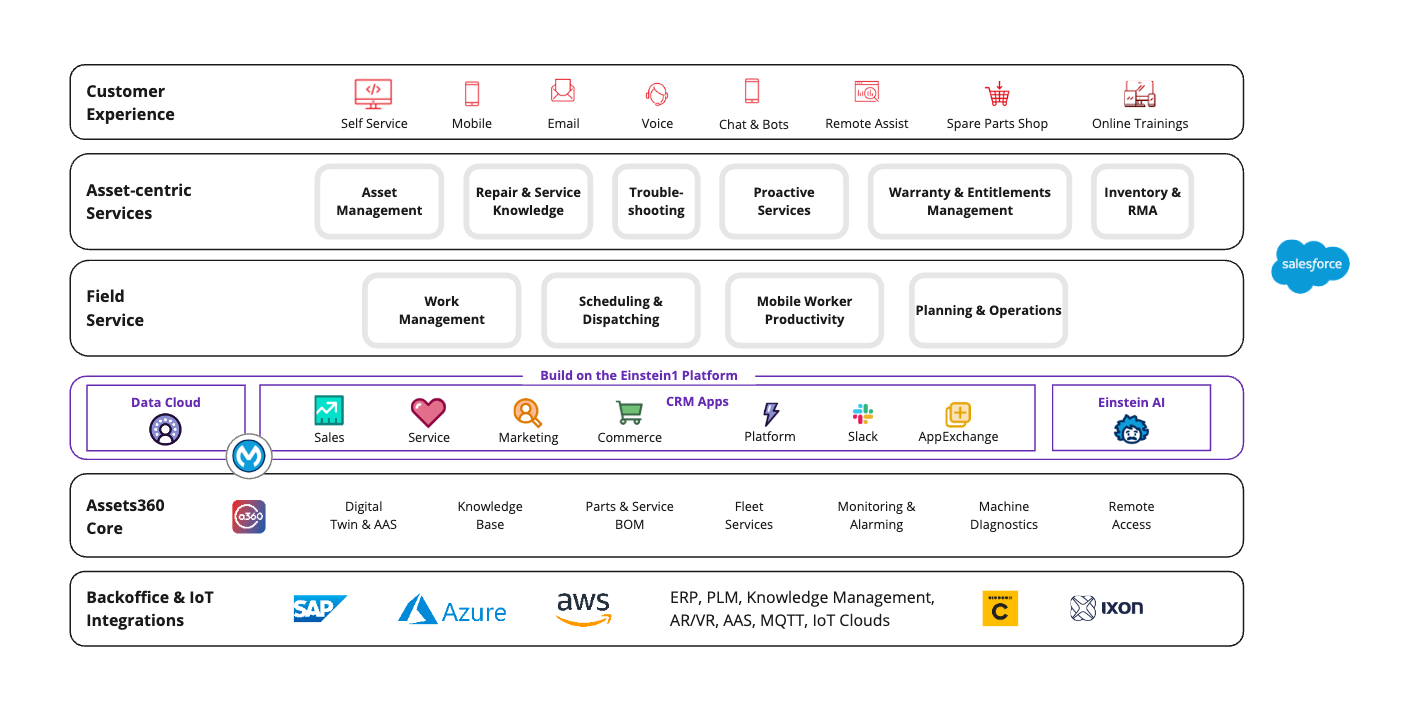
The figure illustrates the functional overview of IoT Asset Management on the Salesforce platform. It highlights how data from ERP, PLM, and IoT systems is consolidated and linked with customer and service data. At the core lies the digital machine file, which integrates master data, maintenance history, operational and sensor data, as well as compliance information. This enables end-to-end processes across service, sales, and marketing – from proactive maintenance and spare parts management to targeted customer campaigns and self-service portals. Complemented by the Digital Product Passport, the solution ensures transparency, increases efficiency in service operations, and unlocks new revenue potential.
IoT Asset Management for Salesforce System Landscape
IoT Data Integration
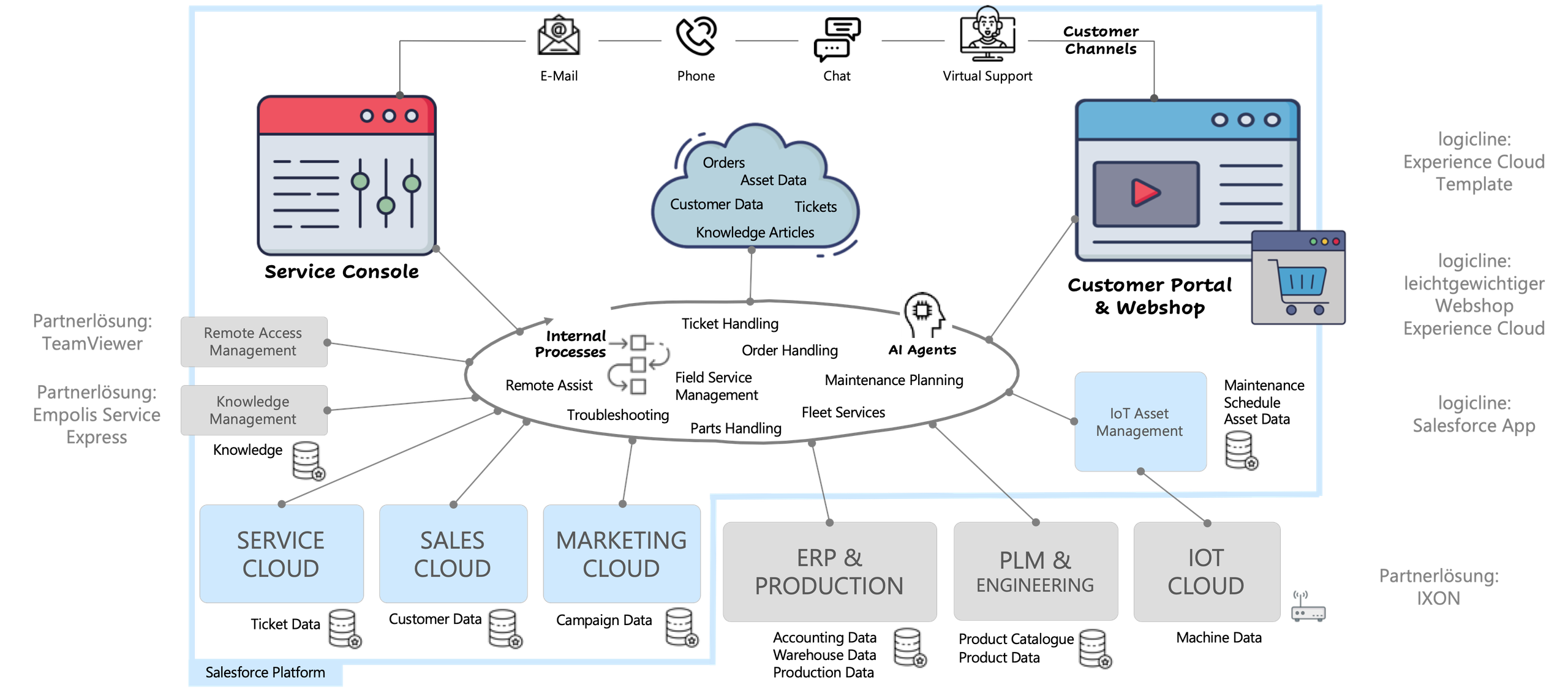
The solution integrates real-time IoT data into Salesforce using a robust, scalable architecture. A dedicated IoT Layer connects diverse IoT platforms and protocols, harmonizes data from multiple sources, and maps sensor information into Salesforce asset objects. While MuleSoft or APIs can be used for ERP and PLM connectivity, the IoT Layer ensures secure, scalable, and domain-specific data exchange with machines and sensors. This differentiation allows organizations to manage complex machine data without overloading the CRM core.
Connectivity Layer:
IoT Middleware: Connects diverse IoT platforms and protocols to Salesforce. Common technologies include Heroku, MuleSoft, or external IoT platforms (e.g., iXon Cloud, AWS IoT Core or Azure IoT Hub).
Data Processing: IoT middleware harmonizes data from multiple sources, converting raw telemetry into actionable insights (e.g., operating conditions, error codes, alarms).
Data Flow:
APIs: RESTful or GraphQL APIs transfer data between the IoT layer and Salesforce.
Event Handling: Real-time events (such as alerts) are pushed into Salesforce using platform events, enabling immediate action.
Data Mapping: Middleware maps IoT device data to Salesforce asset objects, ensuring proper alignment with existing data structures (e.g., hierarchical machine relationships).
Data Storage and Syncing:
No Permanent Storage in Salesforce: Data is accessed in real-time or synced selectively (e.g., critical alerts) to minimize storage costs.
Historical Data: Long-term data storage and advanced analytics can be maintained in external data lakes or third-party solutions, accessible via integration.
Security and Compliance:
End-to-end encryption ensures data security during transfer.
Compliance with GDPR, CCPA, and other data protection standards ensures safe handling of IoT data.
Modules and Native Asset Management in Salesforce
The solution extends Salesforce’s standard functionality with specific modules and native features for managing IoT-enabled assets.
Enhanced Asset Object:
Hierarchical Relationships: The asset object supports complex hierarchies, such as parent-child relationships for assemblies and subassemblies (e.g., turbines, gears).
Custom Fields: IoT-specific fields (e.g., operating hours, sensor readings, thresholds) are dynamically updated via middleware integration.
Asset Visualization Widgets:
Machine Tree: Visual representation of machine hierarchies, enabling easy navigation and status monitoring.
Maintenance Calendar: Displays planned maintenance schedules and flags overdue tasks.
Digital Twin: Provides a virtual model of the machine, including real-time operational data.
IoT-Driven Functions:
Proactive Maintenance: Automatically creates service cases or work orders based on predefined IoT triggers (e.g., temperature spikes, vibration anomalies).
Alarm Management: Real-time alerts with root cause analysis linked directly to the relevant asset.
Performance Dashboards: Built-in analytics for KPIs such as uptime, failure trends, and service costs, powered by Salesforce’s Einstein Analytics.
Self-Service Customer Portal (via Salesforce Experience Cloud):
Customer Access to Assets: Enables customers to view their installed base, check machine status, and retrieve historical data.
Ticketing and Service Requests: Allows customers to raise issues linked directly to specific assets.
Spare Part Orders: Integration with e-commerce functionalities for ordering components tied to the asset's specifications.
Integration and Scalability:
Third-Party Extensions: Plug-and-play integrations with tools like TeamViewer (remote support) or Empolis (knowledge management).
Scalability: Supports a growing asset base through modular extensions and cloud-native architecture.
Salesforce Standard Features & Their Strengths (with relevance to IoT Asset Management)
For IoT Asset Management, these Salesforce standard features form the backbone of the application. As summarized in the feature table, they enable us to unify customer and asset data, automate service workflows, and apply AI for predictive maintenance and spare part forecasting. Experience Cloud portals extend these capabilities directly to customers, while our dedicated IoT layer ensures secure and scalable data exchange with machines, sensors, and back-end systems. Together, these features transform raw IoT signals into actionable business value – powering predictive services, customer self-service, and new business models such as Equipment-as-a-Service.
Feature | Description / Capabilities | Strengths for IoT Asset Management |
|---|---|---|
Customer 360 (Unified CRM Apps) | Integrated applications (Sales, Service, Marketing, Commerce) built on a shared data foundation. | Unified view of customer and machine data, seamless connection of IoT data with service and sales processes. |
Data Cloud | Unifies and organizes massive amounts of structured, unstructured, and real-time data. | Merges machine data, service history, and customer information – foundation for Digital Twin and predictive maintenance. |
Agentforce (AI Agents) | Salesforce framework for autonomous, AI-driven agents (e.g., Service Copilot, Maintenance Agent). | Automated maintenance suggestions, AI-based service planning, intelligent recommendations powered by IoT data. |
Sales Cloud | End-to-end sales process management: leads, opportunities, forecasts, product & quote management. | Use IoT insights for cross- and upselling (e.g., spare parts, modernizations). |
Service Cloud | Customer service platform: case management, omnichannel support, automation. | Automatically create service cases from IoT sensor signals, integrated with the digital machine file. |
Marketing Cloud | Marketing automation and personalized journeys across email, mobile, web. | Targeted campaigns triggered by IoT data (e.g., when maintenance or a software update is due). |
Commerce Cloud | E-commerce functionality integrated into Salesforce. Covers ordering, payments, fulfillment. | Direct spare part sales through self-service portal, linked with IoT-based maintenance events. |
Einstein / AI Features | Predictive insights, intelligent recommendations, AI-powered analytics. | Predictive maintenance, spare part forecasting, next-best-action recommendations for service teams. |
Low-Code / No-Code Tools (e.g., Flow) | Tools for workflows, approvals, and automation – without coding. | Easily implement IoT use cases, such as auto-creating work orders when sensor data hits thresholds. |
Reports, Dashboards & Analytics | Standard reporting and visualization for KPIs and trends. | Transparency into machine utilization, downtime, service performance. |
Experience Cloud (Portals) | Self-service portals for customers and partners. | Customers can directly access maintenance plans, machine data, and order spare parts. |
Integration (IoT Layer, APIs) | Seamless connectivity to ERP, PLM, and IoT platforms. | The IoT Layer ensures easy integration of IoT sensors and ERP systems – enabling a complete digital machine file and harmonized service processes. |
Security & Compliance | Enterprise-grade security, encryption, role-based access. | Protects sensitive IoT data (e.g., operational data), fully compliant with GDPR and industry standards. |
One of the most powerful advantages of the Salesforce platform is its Low-Code / No-Code capability, which allows organizations to adapt, extend, and automate the IoT Asset Management solution without complex custom development. Using tools such as Salesforce Flow, App Builder, and declarative automation, business users and administrators can quickly tailor processes to their unique needs.
For example, service teams can configure automated workflows that create work orders whenever IoT sensor data exceeds a threshold, or define approval processes for warranty claims without writing a single line of code. Similarly, dashboards and machine lifecycle reports can be customized with drag-and-drop tools, ensuring that managers always see the KPIs that matter most to them.
This flexibility ensures that IoT Asset Management is not a static application, but a scalable and adaptable platform that evolves with changing customer requirements, new business models (e.g., Equipment-as-a-Service), and industry-specific processes. For instance, manufacturers can extend the solution with compliance reporting in regulated industries, or implement usage-based billing models – all through Low-Code configuration.
This ensures that IoT Asset Management is not just a tool for managing machines, but a strategic enabler for predictive services, customer-centric innovation, and new revenue-generating business models.
For more information please refer to the official Salesforce Product Documentation:
https://help.salesforce.com/s/products .